
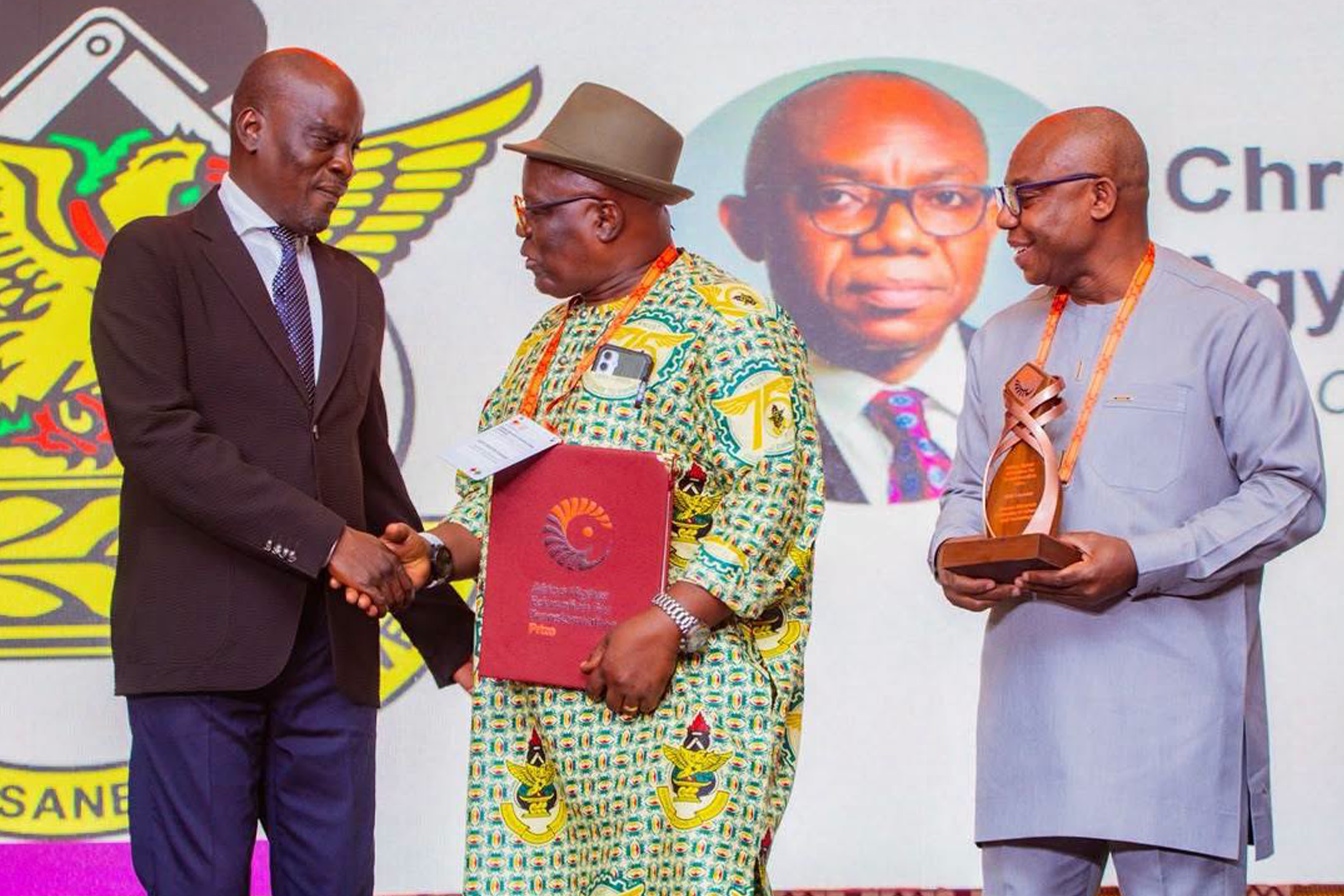
The Kwame Nkrumah University of Science and Technology, Kumasi (KNUST) has received the Africa Higher Education for Transformation (AHEFT) Prize for Excellence in Research and Innovation in recognition of the University’s contribution to research, innovation and national development.
The Vice-Chancellor, Professor Christian Agyare, received the award on behalf of the University at the inaugural Africa Higher Education for Transformation Prize Recognition Ceremony in Accra, as part of the Higher Education Transformation Convening.
He was accompanied by the Minister of Education, Hon. Haruna Iddrisu, and Professor Kofi Owusu-Daaku, Lead of the Mastercard Foundation Scholars Program at KNUST.
The AHEFT Prize recognised five institutions for their contributions to transforming higher education in Africa.
KNUST was recognised in the Excellence in Research and Innovation category for building a research-to-innovation ecosystem and demonstrating how science, technology, entrepreneurship and industry collaboration can contribute to economic transformation, job creation and public impact.
In his acceptance remarks, Professor Agyare acknowledged the support of the Government of Ghana, particularly the Ministry of Education, which he described as a major source of funding for the University.
He dedicated the award to KNUST’s faculty, students, alumni and past and present leadership, saying the achievement reflected their collective efforts.
“When it comes to research and innovation, students are the ones championing it,” Professor Agyare said, highlighting the role of students in advancing innovation at KNUST.
The Vice-Chancellor said the AHEFT Prize would further encourage the University as it pursued its vision of moving “from excellence to global eminence.”
“With this award, it is going to motivate us and then catapult us to get to the global eminence that we have all tasked ourselves to deliver,” he said.
As KNUST marks its 75th anniversary, Professor Agyare said the University’s founding mandate in science and technology continued to shape its research and academic direction, while it increasingly responded to emerging areas, including disruptive technologies and health research.
He cited the Kumasi Centre for Collaborative Research in Tropical Medicine (KCCR) as an example of KNUST’s contribution to national research and public health, particularly during the COVID-19 pandemic, when the Centre worked alongside the Noguchi Memorial Institute for Medical Research.
Professor Agyare also highlighted KNUST’s growing work in artificial intelligence (AI), including research and institutional applications, as well as the University’s contribution to the development of Ghana’s national AI strategy.
He expressed appreciation for the recognition on behalf of the University’s Management, faculty and students, saying the award would serve not as an endpoint but as encouragement to achieve more.
“We are very grateful, and we believe that this award is going to help us achieve more,” he said.


